













|
|
|
|
|
|
|
|
|
|
|
|
|
|
|
|
|
|
|
|
|
|||||||||||||
|
|
|||||||||||||||
|
|
|
|
|
|
|
|
|
|
|
|
|
|
|||
|
|
|
|
|
|
|||||||||||
|
|
|||||||||||||||
Featured Artist |
||
JESSIE ARMS BOTKE |
||
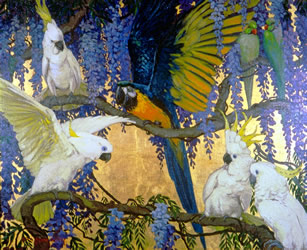 Jessie Arms Botke (1883-1971) Macaw and Cockatoos oil and gold leaf on canvas, mounted on panel 25" x 30" Courtesy of The Irvine Museum Collection at the University of California, Irvine |
||
Born on May 27, 1883, in Chicago, Illinois Jessie Hazel Arms was born on May 27, 1883, in Chicago, Illinois. Her father was William Aldis Arms, a salesman and store clerk born in Massachusetts, and her mother was Martha C. Arms, born in New York. She grew up in Chicago and attended Lincoln Public School and Lakeview High School. In 1897, at the age of fourteen, she took summer classes at the School of the Art Institute of Chicago. In 1902, she began attending full time, studying with portrait painter, John C. Johansen (1876-1964). She also studied for one summer with Charles Woodbury (1864-1940) in Ogunquit, Maine. Moving to New York City in 1911, she worked at Herter Looms until 1915, preparing tapestry cartoons under the guidance of Albert Herter (1871-1950). She developed a special talent for depicting birds and traveled to San Francisco to assist Herter with a mural for the St. Francis Hotel. In 1914, Arms traveled to Santa Barbara to assist Adele McGinnis Herter (1869-1946), Herter's wife, with the decoration of a private home. On a brief stopover in Chicago, she met the Dutch-born artist Cornelis Botke (1887-1954). They were married in Leonia, New Jersey, on April 15, 1915. They had one child, a son named William. Botke and her husband then moved to Chicago where they collaborated on two major mural commissions: one for the Kellogg Company; the other for Noyes Hall at the University of Chicago. They visited California in 1918, and moved there the following year, settling in Carmel. From 1923 to 1925 they traveled throughout Europe. In 1927, Jessie and Cornelis purchased a small ranch in Wheeler Canyon near Santa Paula, where they remained the rest of their lives. Although Jessie Botke regularly sketched en plein air, her work was accomplished in the studio. It is decidedly elaborate, elegant and exotic, very much in the American Art Deco manner. She focused on decorative paintings of birds and plants, both domestic and exotic. She worked in oil, watercolor, or gouache and often employed gold and silver leaf in the background. She painted several murals and her paintings were widely exhibited throughout the United States. Botke was a member of the California Art Club, the California Water Color Society, the National Association of Women Artists, the Chicago Galleries Association, and the Foundation of Western Art. Her many awards included the Martin B. Cahn Prize, at the Art Institute of Chicago in 1918; the Shaffer Prize, at the Art Institute of Chicago in 1926; and the Carpenter Prize, at the Chicago Society for Sanity in Art in 1938.
|